AWSG Chamber
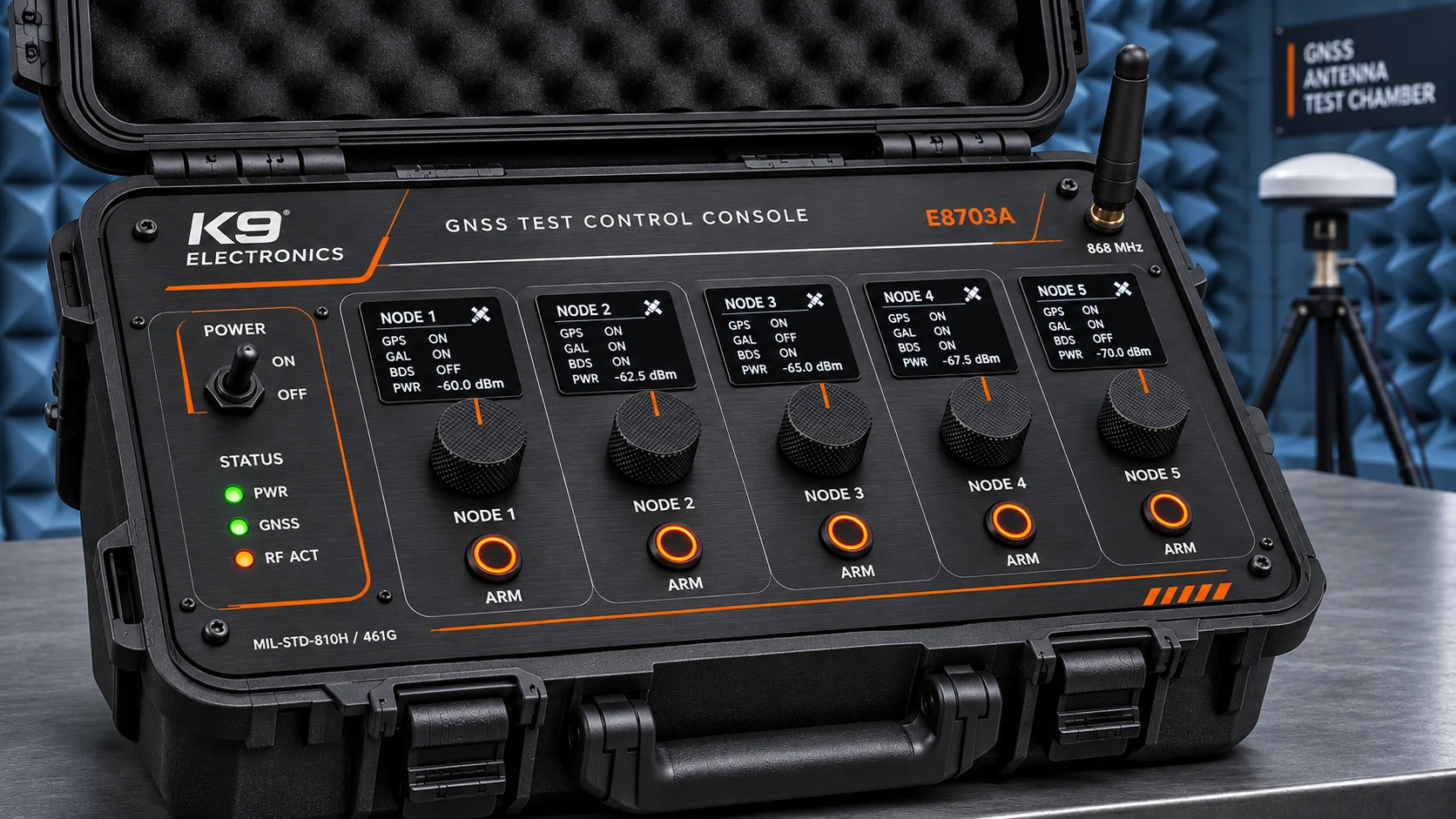
A multi-node, over-the-air GNSS interference system for CRPA and adaptive anti-jamming antenna testing inside your chamber — five radiating emitter nodes placed around the device under test, run from a single wireless console.
Why over-the-air, multi-node testing
A controlled reception pattern antenna (CRPA) rejects interference by steering spatial nulls toward each jamming direction. An N-element array can null up to N−1 directions. A single interference source — whatever its waveform — arrives from one direction and is simply nulled. Meaningful evaluation of the array’s spatial processing therefore needs interference arriving from several directions at once. AWSG Chamber provides that by radiating from several nodes placed at real angles around the antenna under test.
Complementary method: AWSG Chamber is a development and stress-test tool for radiated, spatial behaviour. It complements conducted AWSG instruments and established GNSS wavefront and chamber-simulation methods rather than replacing formal qualification.
Preliminary specifications
Waveform profiles
Non-Stationary Random
Pseudo-random variation of waveform parameters provides a repeatable stimulus for evaluating CRPA behaviour when interference statistics change with time.
Fast Wideband Sweep
Rapid swept-frequency profile across the GNSS L-band for observing adaptive response as interference conditions change.
CW Tone
Controlled single-frequency output for baseline and comparative testing.
Linear Ramp
Controlled frequency-ramp profile for time-varying spectral test scenarios.
Adaptive Cycling
Automated cycling between defined waveform profiles for repeatable stress-testing.
Chamber-based by design
Because the nodes radiate, AWSG Chamber is intended for use inside a shielded or anechoic chamber, which contains the emissions and keeps operation licence-exempt. Node placement sets the directions of arrival; the operator sets each node’s waveform profile and output level from the console and arms all nodes together for a synchronised, repeatable test.