AWSG — Resilient PNT Threat Emulation — K9 Electronics Ltd

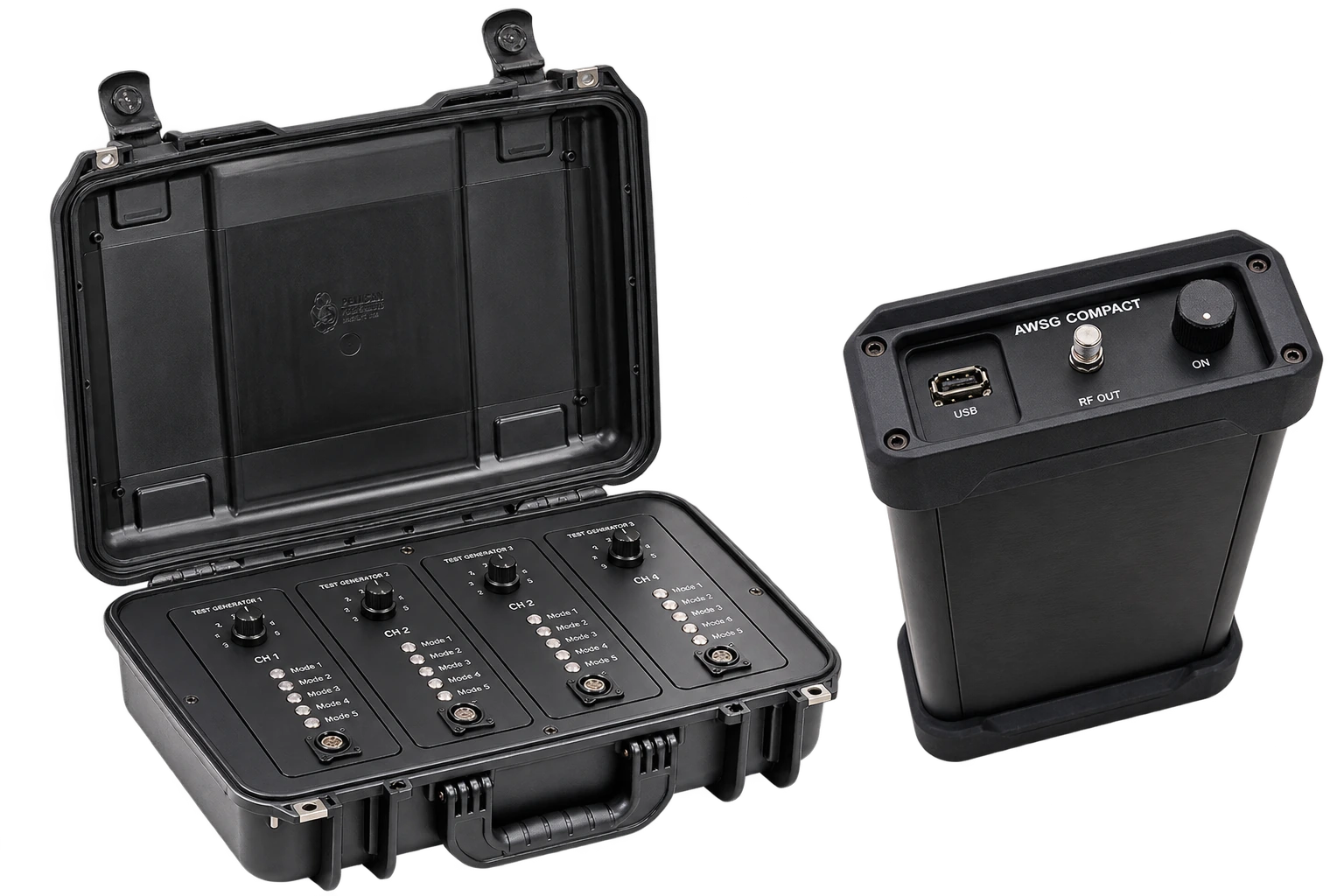
Professional GNSS waveform generation. Two form factors.

Standard CRPA test methodologies use static CW tones from a single direction. Resilient PNT demands more. AWSG is a phase-coherent multi-channel RF generator producing GNSS waveform generation waveforms that expose the true performance envelope of any CRPA or adaptive anti-jam system — dynamic nulling verification at a fraction of the cost of constellation simulators.

2
Product Variants
8
Threat Waveform Modes
<1ms
Mode Switch Time
6wk
Lead Time From Order
ITAR-free
UK Sovereign Supply

Your constellation simulator leaves a critical gap

GNSS constellation simulators — including software-defined platforms combined with vector signal generators — generate defined, repeatable interference scenarios. That is exactly what makes them excellent for satellite signal fidelity testing, and exactly what makes them insufficient for CRPA algorithm stress-testing.

Convergence time windows, degrees-of-freedom exhaustion, covariance stationarity assumptions, AGC hunting — none of these vulnerabilities are exposed by a defined CW tone or AWGN source from a known direction. Your CRPA datasheet null depth was almost certainly measured against precisely that scenario.

If your CRPA was validated using a constellation simulator's built-in interference generator, you know how it performs against a defined threat. AWSG tells you how it performs against an intelligent one.

Current test methodology
Static CW tone — single direction
Algorithm converges once, holds indefinitely. No AGC stress. No degree-of-freedom exhaustion. No convergence window exploitation. Null depth figure looks excellent on a datasheet.
Operational reality
Frequency-agile, non-stationary interference
Waveforms that change faster than convergence time. Signals that appear to arrive from multiple directions simultaneously. Amplitude variation that hunts AGC circuits. The algorithm is never given a stable problem to solve.
AWSG addresses this
Intelligent algorithm stress-testing
Eight distinct threat modes. Sub-millisecond profile switching. Four independent channels. Works alongside your existing constellation simulator — not instead of it. The only portable system designed specifically to stress adaptive beamforming algorithms.

Eight threat modes. Two form factors.

Both AWSG variants share the same five confirmed waveform profiles. Each targets a distinct vulnerability in CRPA adaptive processing — deployable from a rugged case system or a pocket-sized machined aluminium unit.

MODE 01
Non-Stationary Random
Pseudo-random frequency hops with varying dwell times and amplitude. Non-stationary statistics that prevent covariance matrix convergence and hunt AGC continuously.
MODE 02
Fast Wideband Sweep
Rapidly sweeping frequency waveform that outpaces adaptive algorithm convergence windows. The null forms on where the interference was — not where it is.
MODE 03
Multi-Tone Generation
Simultaneous multiple frequency generation creating apparent spatial sources that consume null degrees-of-freedom budget. Exhausts a 4-element CRPA's nulling capacity from a single transmitter.
MODE 04
Chirp / Linear Ramp
Linear frequency ramp generating Doppler-like signatures that confuse direction-of-arrival estimators. Particularly effective against STAP and SFAP algorithm implementations.
MODE 05
Burst / Amplitude Pulsing
Sub-millisecond on/off amplitude patterns creating AGC hunting transients during which beamforming weight calculations are corrupted. Effective null depth degradation without power increase.
MODE 06
Programmable Mode Switching
Rapid switching between modes at intervals shorter than CRPA convergence time. Contrast-scored transition matrix ensures consecutive modes are maximally statistically distinct — the algorithm is always reconverging, never stabilising.
MODE 07
Pattern / Sequence
Pre-programmed waveform sequences from a configurable library. Enables repeatable, documented test scenarios — load the same pattern across multiple test sessions for consistent, comparable results.
MODE 08
Auto-Switch
Fully autonomous mode cycling driven by a contrast-scored transition matrix. Each consecutive mode is selected to maximise statistical difference from the previous — the adaptive algorithm is never given the same problem twice.

Two variants. One architecture.

Preliminary — Subject to Finalisation
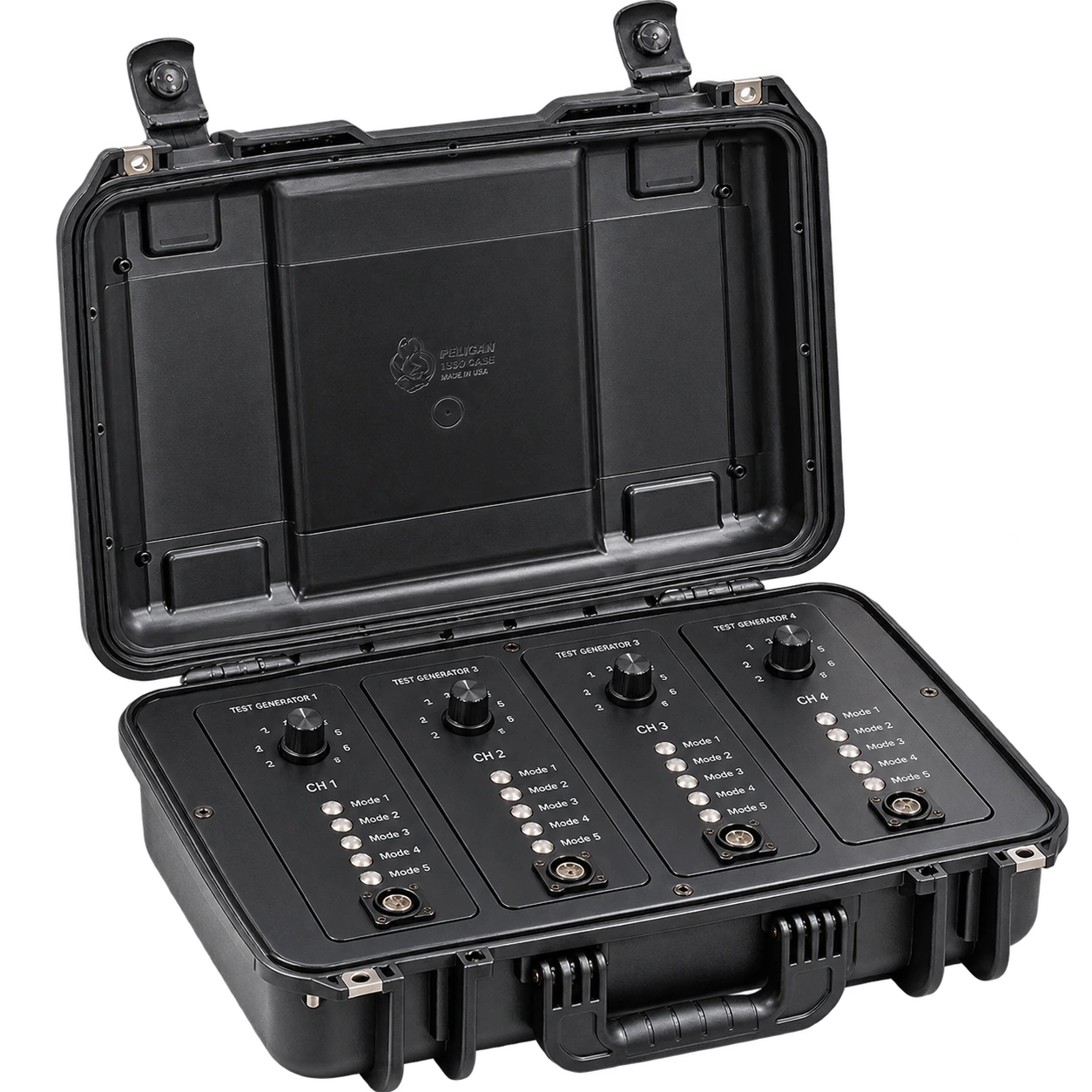
AWSG Field
4-Channel Rugged Case System
Multi-channel field deployment
Channels4 independent — 1 to 4 selectable by operator
Frequency CoverageGPS L1/L2/L5 · GLONASS G1/G2 · Galileo E1/E5a/E5b · BeiDou B1/B2/B3
1100 – 1650 MHz — full GNSS constellation coverage
Waveform ModesCW Tone · Non-Stationary Random · Swept Frequency · Linear Ramp · Adaptive Cycling (Phase 2: +3 profiles)
Mode Switch Time<1 ms
PowerMains (100–240V AC) + integrated battery — 4hr+ runtime
ControlLaptop via USB or Ethernet — K9 DMS Control software
EnclosureRugged carry case — approx 500 × 380 × 200 mm, IP54
WeightTarget <8 kg including battery
ComplianceCE marked (UK Radio Equipment Regulations 2017) — ITAR-free UK sovereign manufacture
Lead Time6 weeks from confirmed order — Q3 2026
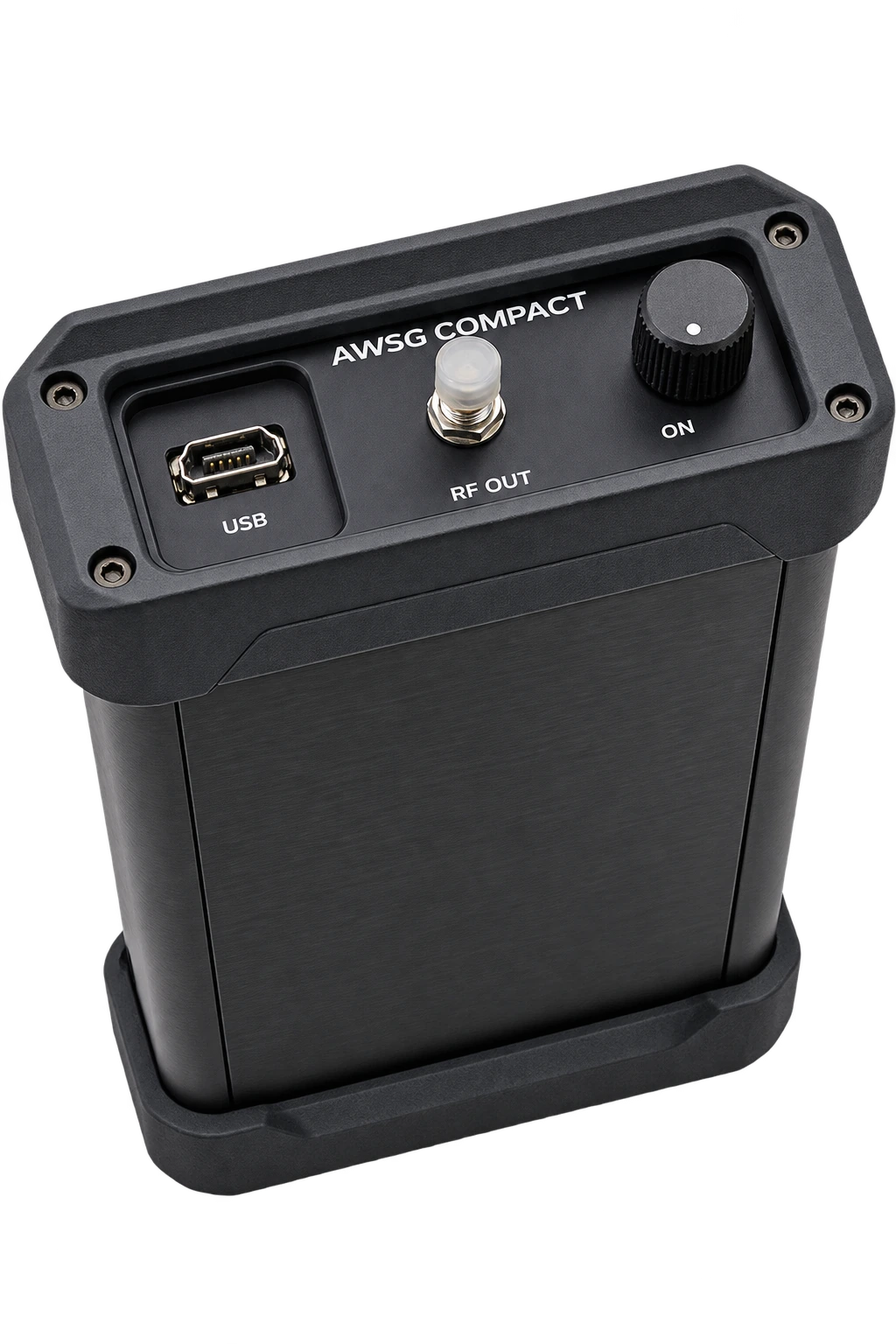
AWSG Compact
1-Channel Hand-Portable Unit
Individual engineer / rapid deployment
Channels1 — standalone self-contained
Frequency CoverageGPS L1/L2/L5 · GLONASS G1/G2 · Galileo E1/E5a/E5b · BeiDou B1/B2/B3
1100 – 1650 MHz — full GNSS constellation coverage
Waveform Modes5 confirmed profiles — selected via rotary switch P1–P5
Mode Switch Time<500 ms on rotary selector change
PowerIntegrated battery — 1 to 2hr runtime, USB-C charge
ControlPre-config via laptop USB-C — standalone field operation
EnclosureCNC machined 6061-T6 aluminium — approx 170 × 65 × 38 mm, IP54
WeightTarget <400 g
ComplianceCE marked (UK Radio Equipment Regulations 2017) — ITAR-free UK sovereign manufacture
Lead Time6 weeks from confirmed order — Q3 2026
Combined Deployment

1× AWSG Field + 2× AWSG Compact creates a 6-channel distributed GNSS waveform generation capability. Four simultaneous modes from the Field unit plus one mode each from the Compact units at different spatial positions — each Compact pre-configured via laptop before deployment, operated standalone in the field.

Already have a constellation simulator? This is what it's missing.

Constellation simulators — whether software-defined with vector signal generator outputs, or wavefront systems — validate CRPA performance against known, defined interference. AWSG validates performance against intelligent, non-stationary threats that no constellation simulator interference library generates. The two are complementary. Most serious CRPA test programmes need both.

Capability Laboratory Constellation
Simulator — £200k–500k+
Record & Replay
Simulator
AWSG
Contact for pricing
GNSS constellation simulation Full Record/replay Not applicable
Static CW / AWGN interference Recorded only
Non-stationary waveform generation Limited Core capability
Adaptive algorithm convergence stress
Null budget exhaustion testing Multiple sources Single unit
Programmable profile switching (<1ms)
Field portable Lab only Record unit
ITAR-free ITAR controlled UK sovereign
Already using a constellation simulator?

If you are using a software-defined GNSS simulator with a vector signal generator for CRPA testing, AWSG addresses the one scenario your existing setup cannot replicate — non-stationary, algorithm-stressing waveforms from a portable, field-deployable unit. Most CRPA test programmes require both. AWSG is the missing half.

Enquire Now ▸

Three reasons organisations choose AWSG

The Democratiser
Professional-grade CRPA testing shouldn't cost a quarter-million pounds
Validate your resilient PNT designs against realistic GNSS waveform generation at a price point that puts professional-grade capability on every engineer's bench. The same phase-coherent multi-channel RF generation as laboratory constellation simulators — without the laboratory price tag.
The Field Kit
Don't bring the platform to the lab. Bring the lab to the platform.
Portable GNSS waveform generation for real-world integration testing. AWSG is a portable alternative to anechoic chamber testing — conduct dynamic nulling verification at your test range, on your vehicle, on your platform, without laboratory infrastructure.
The Agile Developer
Shorten your dev cycles with a phase-coherent signal source at every bench
Give every algorithm developer their own GNSS waveform generator. Iterate on adaptive beamforming code against realistic non-stationary waveforms without booking shared test facilities. AWSG pays for itself in the first development sprint.

Any organisation that develops, evaluates or procures CRPA systems

[01]
CRPA Manufacturers
Validate product performance against the intelligent waveform generation threats your military and government customers are procuring against. Know your system's real performance envelope before your customer finds out in the field.
[02]
Military Test Ranges
Portable, calibrated, rapidly deployable. AWSG generates repeatable advanced threat scenarios for CRPA qualification and platform integration testing without laboratory infrastructure requirements.
[03]
Defence Procurement Agencies
Independent evaluation of CRPA product claims before procurement commitment. Understand how candidate systems perform against next-generation threats, not just the scenarios vendors chose to test against.
[04]
System Integrators
Verify CRPA performance after platform integration. Confirm null depth and algorithm performance are maintained in the installation configuration before delivery to end user.
[05]
Research Institutions
Generate controlled, repeatable non-stationary interference scenarios for adaptive algorithm research. Affordable access to realistic calibrated waveforms previously unavailable outside government test facilities.
[06]
GNSS Receiver Manufacturers
As anti-jam features become standard in commercial receivers, understand how your implementations perform against the real threat environment — not just the interference types defined in legacy test standards.

Production slots available from Q3 2026

AWSG is currently in final development. We are gauging market interest ahead of production commitment. Early enquiries will be prioritised for first-batch allocation.

All enquiries are handled directly by K9 Electronics technical staff. An NDA can be executed prior to detailed technical discussion.

  • No obligation — register interest and receive a technical overview
  • NDA available for detailed capability discussion
  • Demonstrations available at K9 Electronics, Northampton Science Park
  • Export licences handled — worldwide supply capability
  • Volume pricing available for multiple unit orders
6
Week lead time
from confirmed order
Field & Compact — Q3 2026

Your details will not be shared with third parties. K9 Electronics Ltd — Company No. 09362883 — Northampton Science Park, UK.